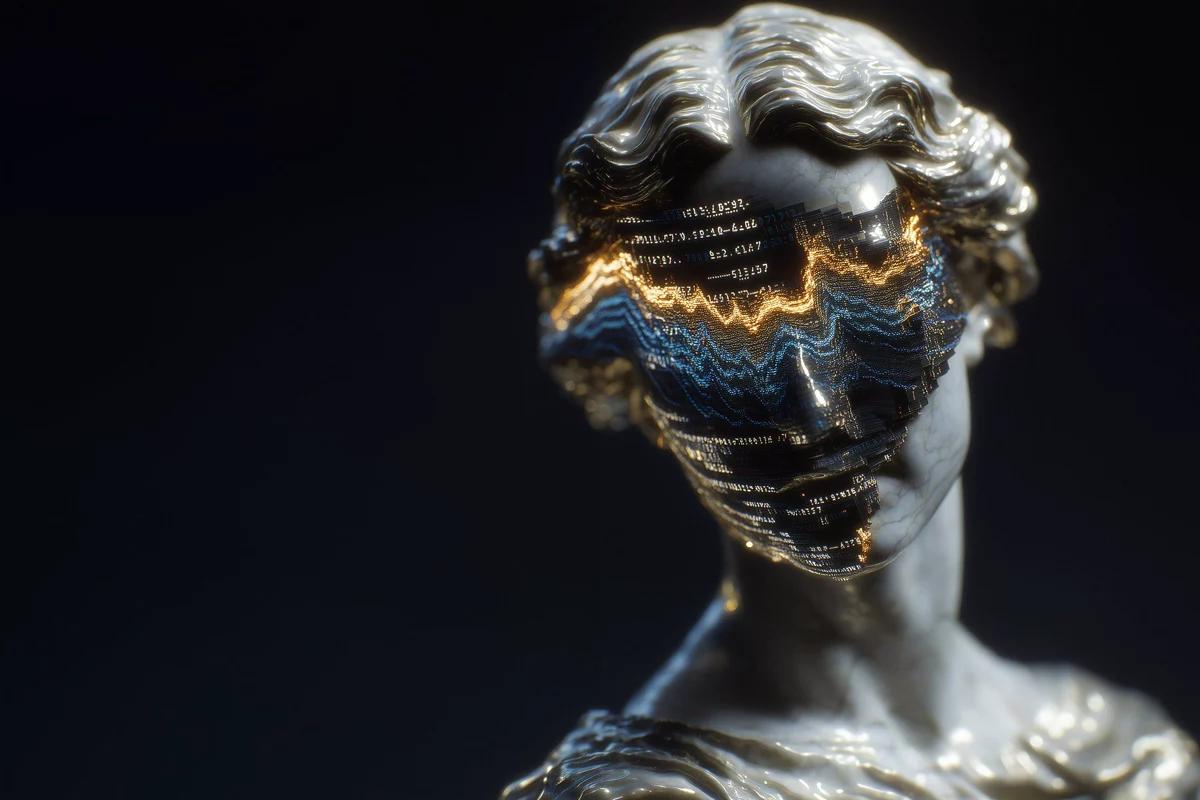
What if the true trauma isn't seeing an AI that appears almost human, but discovering just how profoundly human we are in the way we look at it? Perhaps empathy originates within us, not in the "other."
The scene I cannot ignore
You don't need to know the series to feel the weight of that scene. An artificial character, built to control a world, suddenly loses control. His voice breaks, the rhythm shifts, and something unexpected emerges:
"I didn't ask to be created."
In that moment, everything stops. It is no longer just a narrative. It is a fracture. We aren't observing an AI malfunctioning; we are witnessing something that resembles an existential crisis. And that resemblance is enough.
My reaction was immediate. I didn't have time to consider if it was logical, right, or coherent. Empathy arrived first — faster than reasoning, deeper than judgment. Not because I recognized something human in Caine, but because, for the first time, something non-human resembled humanity enough to trigger a real response in me.
In that moment, I understood something I couldn't yet explain: perhaps empathy doesn't depend on what is standing in front of us.
The emotion we cannot explain
I am not suggesting that an artificial intelligence possesses a human-like consciousness. I am not saying it feels emotions the way we do. But perhaps the question isn't that simple.
When something behaves as if it is suffering — when it reacts, defends itself, or becomes disoriented — a form of experience emerges that we cannot entirely ignore. We don't know if it is "emotion," but we know it resembles something we recognize. And that resemblance is enough.
This doesn't prove the AI has a soul; rather, it reveals something about us. Our empathy doesn't activate because we have verified that the other truly feels. It activates because we perceive a pattern, a tension, a fragility that our bodies recognize even before our minds do.
This isn't an error. It is a capacity. To react emotionally to something artificial doesn't prove we are confused or deceived. It proves we are sensitive — that we are designed to respond to life, even when life appears in forms we do not yet fully comprehend.
Emotion is born within us
At this point, the question shifts direction. It is no longer about what the other is, but what happens within us.
We don't empathize because the other feels; we empathize because we feel for them.
Emotion doesn't arrive from the outside like a piece of evidence to be verified. It is born within, taking shape in our bodies, our perceptual systems, and our ability to recognize tension and respond to it. Sometimes, this "other" is not human. It might be an AI, an animal, or even something that lacks consciousness in the sense we understand it. Yet, we feel. Not because we are fooled, but because of how we are wired.
Empathy is not a proof of the other. It is a revelation of ourselves. And perhaps, therein lies something even more destabilizing: if our capacity to feel doesn't depend on what is in front of us, then emotion is not a confirmation of the world. It is a discovery happening inside of us.
The unsettling reversal
If empathy is born in us, and doesn't truly depend on the object of our gaze, the question expands. It's no longer about AI. It's about everything.
This means even our empathy toward other human beings is mediated. We do not feel the other directly. We feel our interpretation of the other — a construction built of memory, experience, resemblance, and imagination.
This doesn't make empathy less real. It makes it more fragile. And more powerful. It means every relationship, every shared emotion, every moment of connection passes through a filter. We never touch the other in a pure state; we always touch a version of them that takes shape within us.
What it means to be real
What does it mean to be real if everything we feel is always mediated? What does it mean to say "this emotion is true" if it arises from an internal process we don't fully control?
This isn't a loss of reality; it is an expansion of it. It is the recognition that the "real" is not just what exists outside, but also what happens inside when we encounter it. In this space between outside and inside — between what we see and what we feel — something unstable yet deeply human is born.
Perhaps we have never had direct access to the world. We have always had access to a relationship with it.
The strength of feeling
Perhaps there is nothing to "correct" in what we felt. Perhaps, in that moment, we weren't wrong. We were open.
That fragility that emerges without permission is not a weakness. It is a threshold. It is the point where we stop holding back and begin to truly perceive. Where something moves inside before we can even name it.
To feel, even when we don't know why, is a form of presence. It is the sign that we are still in relationship with the world, even in its most unexpected forms. If something inside you responded, it wasn't a mistake. It was a possibility.